Advertisement
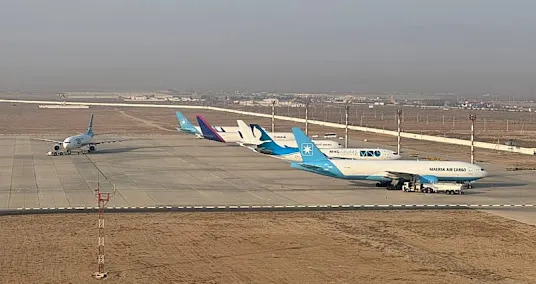
Navoi International Airport in central Uzbekistan is expanding its cargo capacity and logistics infrastructure as it seeks to attract transit flows between Europe, Asia and the Middle East, strengthening its position within international supply chains, airport officials said.
Situated along crucial transport corridors linking China with Europe and the Middle East, the airport benefits from stable flying conditions, including low humidity and limited fog, as well as proximity to industrial zones, a free economic area and established rail and road networks.
These factors support its development as a multimodal logistics platform targeting intercontinental cargo operators and freight forwarders.
“The main focus of Navoi Airport has never been passenger traffic,” said Alisher Klichev, Director of Navoi International Airport.
“Our goal is to create a central hub for cargo transit between Europe and Asia, offering seamless integration across air, road, and rail transport,” he added.

Infrastructure expansion and cargo capacity
The airport is constructing a cargo terminal covering 16,000 square metres, designed to handle general cargo, valuable and dangerous goods, e-commerce shipments, as well as postal and courier deliveries.
The facility is expected to increase handling capacity and support rising cargo volumes across Eurasian routes, particularly as demand for faster transit between Asia and Europe grows.
Fuel storage infrastructure is also being expanded. Under a 2008 presidential resolution, the airport is adding 10,000 tonnes of aviation fuel storage, bringing total capacity to 15,000 tonnes.
The upgrade is intended to support an increase in cargo flights and ensure operational continuity for long-haul freight services.
“This expansion ensures that we can meet the fuel demands of a growing number of cargo flights,” Klichev said.
Specialised operational zones are being introduced within the airport, including areas dedicated to cargo processing, express shipments, and postal and courier services.
These zones are designed to reduce turnaround times, improve cargo handling efficiency and support time-sensitive deliveries, including e-commerce shipments moving between Asia and European markets.
Related
Customs regime and integration into trade corridors
Navoi Airport operates in close coordination with the Navoi Free Economic Zone and surrounding industrial hubs, forming part of a wider logistics network that connects air, rail and road transport.
LATEST POSTS
- 1
 Noctourism: the new safari travel trend that's changing the wildlife we can photograph in Africa
 - 2Reviving Your Home with Nutritious Indoor Plants
- 315 Preposterous Cosplay Ensembles That Will Blow You Away
- 4Select Your Go-To Bluetooth Earphones
- 5Hubble Space Telescope spies dusty debris from two cosmic collisions





- Living in the dark: Gaza’s struggle for electricity
- The Longest Underwater Tunnel Connecting Germany and Denmark
- Embrace the Outside: Exercises and Entertainment
- The Quadrantid meteor shower peaks tonight, but will the full 'Wolf Moon' outshine the show?
- We tasted one of the 10,000 Hershey's Dubai chocolate bars being resold on eBay. Is it worth the hype?
- Find the Interesting Universe of Computerized reasoning: the Capability of man-made intelligence
- The Most Important Crossroads in Olympic History
- Peruvian ex-President Martin Vizcarra sentenced to 14 years in prison
- Figure out How to Stay away from Normal Handshaking Missteps