Advertisement

By Eduardo Baptista
BEIJING, Dec 1 (Reuters) - China's first crewed spacecraft to be ruled unfit to fly in mid-mission will be sent back to Earth for experts to assess the damage it sustained more closely, state broadcaster CCTV reported on Monday.
On November 5, the Shenzhou-20 spacecraft was meant to bring its crew back to China just after finishing a six-month stay aboard Beijing's permanently inhabited space station Tiangong.
But after the Shenzhou-20 crew discovered a crack in the window of the vessel's return capsule right before takeoff, the return mission was delayed - a first in China's human spaceflight program.
The vessel's crew was forced to return to Earth in a different spaceship nine days later, temporarily leaving Tiangong and its remaining trio of resident astronauts without a flightworthy vessel.
China's space-industrial complex raced to remove that risk by working overtime to execute its first emergency launch mission on November 25, just 20 days after the initial delay was announced.
But the future of the damaged Shenzhou-20 vessel, which remains docked at the Chinese space station, was unknown until CCTV's televised report on Monday.
Ji Qiming, a spokesperson for the China Manned Space Agency, told the state broadcaster that Shenzhou-20 would return without crew to Earth, adding that on its way back it would "obtain the most authentic experimental data", without elaborating further.
Jia Shijin, a designer of the Shenzhou spacecraft, revealed to CCTV more details about the tiny crack that permanently altered China's crewed spaceflight schedule.
"Our preliminary judgement is that the piece of space debris was smaller than 1 millimetre, but it was travelling incredibly fast. The resulting crack extends over a centimetre," Jia said.
"But we can't directly examine it in orbit, we will study it closely when Shenzhou-20 returns."
Jia added that the decision to delay the Shenzhou-20 return mission was based on a worst-case scenario where the window crack might spread, leading to cabin depressurisation and the ingress of high-speed gases.
If this happened, it could then rapidly overwhelm life-support systems and prove fatal to the astronauts.
(Reporting by Eduardo Baptista; editinjg by Mark Heinrich)
LATEST POSTS
- 1
 Best Wellness Tracker Keep You On target
 - 2Farewell, comet 3I/ATLAS! Interstellar visitor heads for the outer solar system after its closest approach to Earth
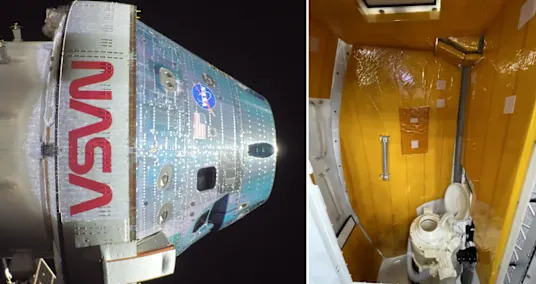
- 3The breakout star of NASA's Artemis 2 moon mission isn't an astronaut — it's the space toilet
- 4Overseeing Individual budgets Successfully
- 5Earth's newfound 'episodic-squishy lid' may guide our search for habitable worlds




- EU Commission prepares €90bn Ukraine loan despite Hungary's veto
- How did this 20-light-year-wide 'Diamond Ring' form in space? Maybe a cosmic bubble burst
- Tatiana Schlossberg, JFK's granddaughter, dies at 35 after terminal cancer diagnosis
- Did we start the fire? A 400,000-year-old hearth sparks new questions about human evolution
- Former school bus aide pleads guilty to assaulting 3 autistic students in Colorado
- Is new Harry Styles music on the way? Fans think so, after a cryptic website and posters pop up.
- Figure out How to Get a good deal on Your Rooftop Substitution Venture
- CDC's upcoming vote on hepatitis B vaccine could impact childhood immunization
- Timex Gives Its Classic Affordable Field Watch a Tactical, Milspec Makeover